History of the Scientific and Organisational Department
BACK
The history of the Scientific and Organizational Department of the institute dates back to 1929 when, on the initiative of the institute’s director, Professor Mykhailo Sytenko, the Department of Periphery, Social Hygiene, and Personnel was established. It was headed by Klavdiia Ostapko, who managed the department until 1941.
Later, in the 1930s, the department was renamed the Department of Social Hygiene and Prevention, and after the Great Patriotic War, it became the Organizational and Methodological Department. In 1985, it was transformed into the Laboratory of Social Hygiene and Injury Prevention (LSGIP), and in 1992, it became the Scientific and Organizational Department (SOD). Over the years, the department was headed by PhD Faina Eliashberh (1946–1954), PhD Anatolii Kravchenko (1954–1964), PhD Halyna Itskova (1964–1972), DMSc Hennadii Fadeiev (1972–1977), DMSc Viktor Berdnikov (1977–1982), Marharyta Hurianova (1982–1985), PhD Volodymyr Krupenia (1985–1991), Prof. Dmytro Yaremenko (1991–2006), and DMSc Oleksandr Korolkov (2006–2018).
In March 2018, the Scientific and Organizational Department was headed by DMSc, Professor Volodymyr Tankut.
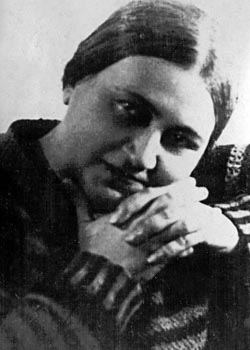 K. Ostapko, Head of the Department of Periphery, Social Hygiene, and Personnel (1929–1941)
 PhD F. Eliashberh, Head of the Organizational and Methodological Department (1946–1954)
 PhD A. Kravchenko, Head of the Organizational and Methodological Department (1954–1964)
 PhD H. Itskova, Head of the Organizational and Methodological Department (1964–1972)
 DMSc H. Fadeiev, Head of the Organizational and Methodological Department (1972–1977)
 DMSc V. Berdnikov, Head of the Organizational and Methodological Department (1977–1982)
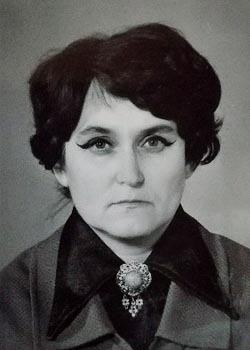 M. Hurianova, Head of the Organizational and Methodological Department (1982–1985)
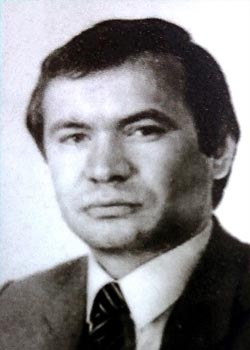 PhD V. Krupenia, Head of the Laboratory of Social Hygiene and Injury Prevention (1985–1991)
 Prof. D. Yaremenko, Head of the Scientific and Organizational Department (1991–2006)
 DMSc O. Korolkov, Head of the Scientific and Organizational Department (2006–2018)
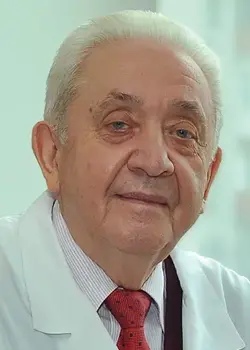 Professor Volodymyr Tankut, Head of the Scientific and Organizational Department (since 2018)
Over its nearly 90-year history, the department has played a significant role in the establishment and development of specialised orthopaedic and trauma medical care for the population of Ukraine, as well as in the prevention of injuries, childhood disabilities, and impairments caused by musculoskeletal disorders.
The department was home to highly qualified specialists and researchers, including PhD H.V. Bezvesylna, DMSc V.S. Kostrykov, DMSc H.M. Sokol, PhD V.B. Tarshys, DMSc V.Ya. Moskin, Prof. V.O. Tankut, PhD T.M. Hrashchenkova, Assoc. Prof. I.I. Ryzhykov, and others.
Professor Volodymyr Tankut, Head of the Scientific and Organizational Department (since 2018)
Over its nearly 90-year history, the department has played a significant role in the establishment and development of specialised orthopaedic and trauma medical care for the population of Ukraine, as well as in the prevention of injuries, childhood disabilities, and impairments caused by musculoskeletal disorders.
The department was home to highly qualified specialists and researchers, including PhD H.V. Bezvesylna, DMSc V.S. Kostrykov, DMSc H.M. Sokol, PhD V.B. Tarshys, DMSc V.Ya. Moskin, Prof. V.O. Tankut, PhD T.M. Hrashchenkova, Assoc. Prof. I.I. Ryzhykov, and others.
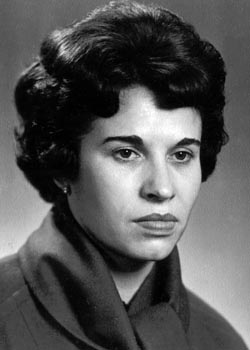 PhD H.V. Bezvesylna
 DMSc V.S. Kostrykov
 DMSc H.M. Sokol
 PhD V.B. Tarshys
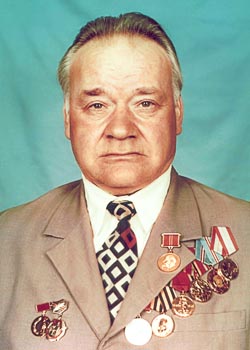 DMSc V.Ya. Moskin
 Prof. V.O. Tankut
 PhD T.M. Hrashchenkova
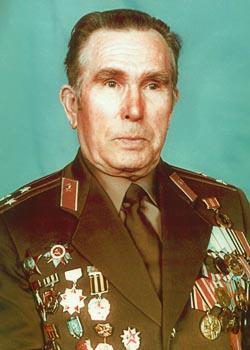 Assoc. Prof. I.I. Ryzhykov
The department’s primary objectives from its inception included the scientific substantiation of the organisation and development of specialised orthopaedic and trauma care for the country’s population, the training of qualified personnel in orthopaedics and traumatology, and providing organisational and methodological support to territorial health authorities and medical institutions. Since then, all scientific, organisational, and methodological activities of the institute have been conducted with the direct involvement of the department.
To achieve these objectives, data on the prevalence, level, and overall structure of trauma and orthopaedic diseases, as well as the population’s need for specialised care, were required. To study the prevalence of orthopaedic diseases, industrial injuries, and the organisation of medical care, the department led selective studies in 1929–1931 in outpatient clinics and hospitals in the Artemivsk district of Donbas, Kryvyi Rih, Luhansk, and Poltava regions. The first expedition, led by M.P. Novachenko, was dispatched in 1929 to the Artemivsk district of Donbas to examine the organisation of medical care in the coal industry. The prevalence of orthopaedic diseases and trauma levels in agricultural regions was studied in the Dykanka district of the Poltava region during an expedition led by V.O. Marks in the summer of 1929. In February 1931, under the leadership of B.S. Havrylenko, an examination of the medical network and trauma care provided to workers in the iron and manganese mining industries in Kryvyi Rih and Nikopol-Marganets was conducted. In the summer of 1931, under the direction of V.D. Chaklin, a similar study was carried out on industrial, including coal mining, enterprises in the Luhansk region. Based on the collected data, models of orthopaedic and trauma institutions were developed, along with guidelines on their material resources, technical equipment, work structure, and specialised care systems for injured and sick individuals, as well as standards for orthopaedic and trauma services.
In 1932, in close collaboration with territorial health authorities, the department began implementing a scientifically substantiated plan for establishing a network of orthopaedic and trauma institutions in Left-Bank Ukraine. The practical activities of these institutions were closely linked to the research work of the institute, which became the central hub for organising, planning, and directing the entire network of orthopaedic and trauma institutions. The department of peripheral care, social hygiene, and personnel played a leading role in this effort.
In 1934, the People’s Commissariat of Health defined the spheres of influence of the Kyiv and Kharkiv Institutes of Orthopaedics and Traumatology. The Ukrainian State Clinical Institute of Orthopaedics and Traumatology, located in Kharkiv, was assigned responsibility for the Left-Bank regions of Ukraine, where work continued on establishing and developing a network of outpatient and inpatient specialised services. As a result, by 1937, 34 peripheral specialised departments with a total capacity of over two thousand beds were operating in industrial centres and agricultural regions of Left-Bank Ukraine. The institute established 27 scientific and support units (NOPs) on their bases, increasing to 29 by the end of 1940.
Assoc. Prof. I.I. Ryzhykov
The department’s primary objectives from its inception included the scientific substantiation of the organisation and development of specialised orthopaedic and trauma care for the country’s population, the training of qualified personnel in orthopaedics and traumatology, and providing organisational and methodological support to territorial health authorities and medical institutions. Since then, all scientific, organisational, and methodological activities of the institute have been conducted with the direct involvement of the department.
To achieve these objectives, data on the prevalence, level, and overall structure of trauma and orthopaedic diseases, as well as the population’s need for specialised care, were required. To study the prevalence of orthopaedic diseases, industrial injuries, and the organisation of medical care, the department led selective studies in 1929–1931 in outpatient clinics and hospitals in the Artemivsk district of Donbas, Kryvyi Rih, Luhansk, and Poltava regions. The first expedition, led by M.P. Novachenko, was dispatched in 1929 to the Artemivsk district of Donbas to examine the organisation of medical care in the coal industry. The prevalence of orthopaedic diseases and trauma levels in agricultural regions was studied in the Dykanka district of the Poltava region during an expedition led by V.O. Marks in the summer of 1929. In February 1931, under the leadership of B.S. Havrylenko, an examination of the medical network and trauma care provided to workers in the iron and manganese mining industries in Kryvyi Rih and Nikopol-Marganets was conducted. In the summer of 1931, under the direction of V.D. Chaklin, a similar study was carried out on industrial, including coal mining, enterprises in the Luhansk region. Based on the collected data, models of orthopaedic and trauma institutions were developed, along with guidelines on their material resources, technical equipment, work structure, and specialised care systems for injured and sick individuals, as well as standards for orthopaedic and trauma services.
In 1932, in close collaboration with territorial health authorities, the department began implementing a scientifically substantiated plan for establishing a network of orthopaedic and trauma institutions in Left-Bank Ukraine. The practical activities of these institutions were closely linked to the research work of the institute, which became the central hub for organising, planning, and directing the entire network of orthopaedic and trauma institutions. The department of peripheral care, social hygiene, and personnel played a leading role in this effort.
In 1934, the People’s Commissariat of Health defined the spheres of influence of the Kyiv and Kharkiv Institutes of Orthopaedics and Traumatology. The Ukrainian State Clinical Institute of Orthopaedics and Traumatology, located in Kharkiv, was assigned responsibility for the Left-Bank regions of Ukraine, where work continued on establishing and developing a network of outpatient and inpatient specialised services. As a result, by 1937, 34 peripheral specialised departments with a total capacity of over two thousand beds were operating in industrial centres and agricultural regions of Left-Bank Ukraine. The institute established 27 scientific and support units (NOPs) on their bases, increasing to 29 by the end of 1940.
 The department’s tasks since its inception have been the scientific justification for the organisation and development of specialised orthopaedic and trauma care for the country’s population, the organisation of training qualified personnel in orthopaedics and traumatology, and providing organisational and methodological assistance to administrative territorial health authorities and medical institutions. Since then, all the institute’s scientific, organisational, and methodological work has been conducted with the direct participation of the department.
To achieve these objectives, it was necessary to obtain data on the prevalence, level, and overall structure of injuries and orthopaedic diseases, as well as the population’s need for specialised care. To study the prevalence of orthopaedic diseases, the state of occupational injuries, and the organisation of medical care, the department conducted sample studies in outpatient clinics and hospitals in the Artemivsk district of Donbas, Kryvyi Rih, Luhansk, and Poltava regions between 1929 and 1931. The first expedition, led by M. P. Novachenko, was sent to the Artemivsk district of Donbas in 1929 to study the organisation of medical care at coal industry enterprises. The prevalence of orthopaedic diseases and the level of injuries in agricultural regions were studied in the Dykan district of the Poltava region during a research expedition led by V. O. Marks in the summer of 1929. In February 1931, under the leadership of B. S. Havrylenko, the network of medical institutions and the state of trauma care for workers at iron and manganese mining enterprises in Kryvyi Rih and Nikopol-Marganets were examined. In the summer of 1931, V. D. Chaklin led a similar study of industrial enterprises, including coal mines, in the Luhansk region. Based on the obtained data, types of orthopaedic and trauma institutions were developed, along with guidelines on their material support and technical equipment, the nature of their work, and the system for providing specialised orthopaedic and trauma care to injured and sick individuals, as well as the norms for orthopaedic and trauma services and specialised medical assistance for the population.
In 1932, in close cooperation with territorial health management authorities, the department began implementing a scientifically grounded set of measures to establish a network of orthopaedic and trauma institutions in Left-Bank Ukraine, whose practical activities were closely linked to the institute’s research work. The institute became the leading centre for organising, planning, and directing the activities of the entire network of orthopaedic and trauma institutions. The Peripheral, Social Hygiene, and Personnel Department played a key role in this work.
In 1934, the People’s Commissariat of Health determined the spheres of influence of the Kyiv and Kharkiv institutes of orthopaedics and traumatology. The Ukrainian State Clinical Institute of Orthopaedics and Traumatology, located in Kharkiv, was assigned the Left-Bank Ukraine regions, where work continued on establishing and developing the outpatient and inpatient network of the specialised service. As a result, by 1937, 34 peripheral specialised departments with a total of more than two thousand beds were operating in the industrial centres and agricultural regions of Left-Bank Ukraine. The institute opened 27 scientific reference points (SRPs) based on these facilities, increasing to 29 by the end of 1940.
In 1934, an Institute for the Rehabilitation of Traumatized Workers was opened in Sloviansk based on an SRP, where medical rehabilitation and follow-up monitoring of orthopaedic and trauma patients requiring sanatorium-resort treatment were conducted according to the methods of the Institute of Orthopaedics and Traumatology.
Qualified personnel were needed for the specialised departments and SRPs. In the late 1920s, the department organised training for intern doctors at the institute in diagnostic and treatment methods for patients with musculoskeletal system disorders, postgraduate training in orthopaedics and traumatology, and courses for training mid-level medical personnel in plaster techniques. Additionally, short-term courses and seminars were held for doctors on current issues in orthopaedics and traumatology.
The department’s tasks since its inception have been the scientific justification for the organisation and development of specialised orthopaedic and trauma care for the country’s population, the organisation of training qualified personnel in orthopaedics and traumatology, and providing organisational and methodological assistance to administrative territorial health authorities and medical institutions. Since then, all the institute’s scientific, organisational, and methodological work has been conducted with the direct participation of the department.
To achieve these objectives, it was necessary to obtain data on the prevalence, level, and overall structure of injuries and orthopaedic diseases, as well as the population’s need for specialised care. To study the prevalence of orthopaedic diseases, the state of occupational injuries, and the organisation of medical care, the department conducted sample studies in outpatient clinics and hospitals in the Artemivsk district of Donbas, Kryvyi Rih, Luhansk, and Poltava regions between 1929 and 1931. The first expedition, led by M. P. Novachenko, was sent to the Artemivsk district of Donbas in 1929 to study the organisation of medical care at coal industry enterprises. The prevalence of orthopaedic diseases and the level of injuries in agricultural regions were studied in the Dykan district of the Poltava region during a research expedition led by V. O. Marks in the summer of 1929. In February 1931, under the leadership of B. S. Havrylenko, the network of medical institutions and the state of trauma care for workers at iron and manganese mining enterprises in Kryvyi Rih and Nikopol-Marganets were examined. In the summer of 1931, V. D. Chaklin led a similar study of industrial enterprises, including coal mines, in the Luhansk region. Based on the obtained data, types of orthopaedic and trauma institutions were developed, along with guidelines on their material support and technical equipment, the nature of their work, and the system for providing specialised orthopaedic and trauma care to injured and sick individuals, as well as the norms for orthopaedic and trauma services and specialised medical assistance for the population.
In 1932, in close cooperation with territorial health management authorities, the department began implementing a scientifically grounded set of measures to establish a network of orthopaedic and trauma institutions in Left-Bank Ukraine, whose practical activities were closely linked to the institute’s research work. The institute became the leading centre for organising, planning, and directing the activities of the entire network of orthopaedic and trauma institutions. The Peripheral, Social Hygiene, and Personnel Department played a key role in this work.
In 1934, the People’s Commissariat of Health determined the spheres of influence of the Kyiv and Kharkiv institutes of orthopaedics and traumatology. The Ukrainian State Clinical Institute of Orthopaedics and Traumatology, located in Kharkiv, was assigned the Left-Bank Ukraine regions, where work continued on establishing and developing the outpatient and inpatient network of the specialised service. As a result, by 1937, 34 peripheral specialised departments with a total of more than two thousand beds were operating in the industrial centres and agricultural regions of Left-Bank Ukraine. The institute opened 27 scientific reference points (SRPs) based on these facilities, increasing to 29 by the end of 1940.
In 1934, an Institute for the Rehabilitation of Traumatized Workers was opened in Sloviansk based on an SRP, where medical rehabilitation and follow-up monitoring of orthopaedic and trauma patients requiring sanatorium-resort treatment were conducted according to the methods of the Institute of Orthopaedics and Traumatology.
Qualified personnel were needed for the specialised departments and SRPs. In the late 1920s, the department organised training for intern doctors at the institute in diagnostic and treatment methods for patients with musculoskeletal system disorders, postgraduate training in orthopaedics and traumatology, and courses for training mid-level medical personnel in plaster techniques. Additionally, short-term courses and seminars were held for doctors on current issues in orthopaedics and traumatology.
 Since 1931, regular cyclic (thematic) courses for improving the qualifications of orthopaedic and trauma doctors had been organised. In the late 1930s, a higher form of qualification improvement was introduced—a clinical residency in the speciality of “Orthopaedics and Traumatology.”
From the early years of the department’s establishment, research on injury prevention and the organisation of medical care for the injured played a crucial role in its activities. By the late 1930s, the department had organised courses to train drivers, tram operators, and police officers in providing first aid to accident victims. Additionally, the institute successfully advocated for the People’s Commissariat of Education to include road safety lessons in school curricula and developed special training courses for teachers on street traffic studies and first aid for accident victims. Ambulances were equipped with standard splints developed by the institute. To improve the quality of specialised care for injured miners, principles for primary medical assistance in mine injuries were developed, along with regulations for the medical and material-technical equipment of underground trauma points.
The Great Patriotic War disrupted the development and improvement of the orthopaedic and trauma care system in the country. After the war, the institute had to restore the previously existing orthopaedic and trauma service. To study the war’s sanitary consequences and assess the state of institutions providing specialised care, expeditions and team inspections were organised. In the summer of 1946, the second expedition, led by H. M. Baturina, was sent to the Dykan district of the Poltava region. Based on the data obtained on the structure and dynamics of orthopaedic pathology, disabling factors, and the state of orthopaedic and trauma care, measures were developed to provide specialised medical assistance to patients in need.
Organisational and methodological issues regarding the restoration of orthopaedic-traumatological care were discussed and resolved at conferences held by the department. By the late 1950s, there were already 40 scientific support points in the regions attached to the institute, which actively worked on the restoration of a network of specialised orthopaedic-traumatological institutions. The organisational-methodological department maintained communication with the support points and the periphery by organising periodic planned trips for institute staff to the locations, calling doctors to the institute, and convening special conferences for scientific support points. Between 1944 and 1957, the organisational-methodological department organised 652 trips for institute staff to peripheral medical institutions to provide methodological, organisational, and medical assistance. A significant contribution to restoring the normal operation of the orthopaedic-traumatological service was made by holding 17 scientific conferences and 5 interregional conferences for medical institutions for war invalids.
Soon, many scientific support points reached such a scientific, practical, and organisational level that they no longer required guidance from the institute. On their basis, the Donetsk Scientific Research Institute of Traumatology and Orthopaedics, departments at medical higher educational institutions in Donetsk, Simferopol, Zaporizhzhia, Luhansk, and Poltava were established.
In the post-war period, social-hygienic studies on the issues of trauma and orthopaedic morbidity were restored at the institute, which were conducted at the initiative and with the direct participation of the staff of the organisational-methodological department.
In 1956, the first trip of a medical team was organised to the virgin lands of the North Kazakhstan and Kokshetau regions to study the state of trauma care and provide practical assistance. In the following 8 years, every year, during the harvesting season, a team of specialists from the institute (V.S. Kostrikov, V.Ya. Moskin, V.P. Pelypenko, S.D. Shevchenko and medical nurses), provided not only consultative and medical, but also organisational-methodological assistance to medical institutions and health authorities in the districts and cities of Kazakhstan. As a result of this work, the first publication in the USSR, co-authored with TsITO, by V.S. Kostrikov and O.M. Morozova, was released, addressing issues of trauma in the virgin lands. In 1961, the third expedition of institute staff took place in the Dykansky district of Poltava region.
Since 1931, regular cyclic (thematic) courses for improving the qualifications of orthopaedic and trauma doctors had been organised. In the late 1930s, a higher form of qualification improvement was introduced—a clinical residency in the speciality of “Orthopaedics and Traumatology.”
From the early years of the department’s establishment, research on injury prevention and the organisation of medical care for the injured played a crucial role in its activities. By the late 1930s, the department had organised courses to train drivers, tram operators, and police officers in providing first aid to accident victims. Additionally, the institute successfully advocated for the People’s Commissariat of Education to include road safety lessons in school curricula and developed special training courses for teachers on street traffic studies and first aid for accident victims. Ambulances were equipped with standard splints developed by the institute. To improve the quality of specialised care for injured miners, principles for primary medical assistance in mine injuries were developed, along with regulations for the medical and material-technical equipment of underground trauma points.
The Great Patriotic War disrupted the development and improvement of the orthopaedic and trauma care system in the country. After the war, the institute had to restore the previously existing orthopaedic and trauma service. To study the war’s sanitary consequences and assess the state of institutions providing specialised care, expeditions and team inspections were organised. In the summer of 1946, the second expedition, led by H. M. Baturina, was sent to the Dykan district of the Poltava region. Based on the data obtained on the structure and dynamics of orthopaedic pathology, disabling factors, and the state of orthopaedic and trauma care, measures were developed to provide specialised medical assistance to patients in need.
Organisational and methodological issues regarding the restoration of orthopaedic-traumatological care were discussed and resolved at conferences held by the department. By the late 1950s, there were already 40 scientific support points in the regions attached to the institute, which actively worked on the restoration of a network of specialised orthopaedic-traumatological institutions. The organisational-methodological department maintained communication with the support points and the periphery by organising periodic planned trips for institute staff to the locations, calling doctors to the institute, and convening special conferences for scientific support points. Between 1944 and 1957, the organisational-methodological department organised 652 trips for institute staff to peripheral medical institutions to provide methodological, organisational, and medical assistance. A significant contribution to restoring the normal operation of the orthopaedic-traumatological service was made by holding 17 scientific conferences and 5 interregional conferences for medical institutions for war invalids.
Soon, many scientific support points reached such a scientific, practical, and organisational level that they no longer required guidance from the institute. On their basis, the Donetsk Scientific Research Institute of Traumatology and Orthopaedics, departments at medical higher educational institutions in Donetsk, Simferopol, Zaporizhzhia, Luhansk, and Poltava were established.
In the post-war period, social-hygienic studies on the issues of trauma and orthopaedic morbidity were restored at the institute, which were conducted at the initiative and with the direct participation of the staff of the organisational-methodological department.
In 1956, the first trip of a medical team was organised to the virgin lands of the North Kazakhstan and Kokshetau regions to study the state of trauma care and provide practical assistance. In the following 8 years, every year, during the harvesting season, a team of specialists from the institute (V.S. Kostrikov, V.Ya. Moskin, V.P. Pelypenko, S.D. Shevchenko and medical nurses), provided not only consultative and medical, but also organisational-methodological assistance to medical institutions and health authorities in the districts and cities of Kazakhstan. As a result of this work, the first publication in the USSR, co-authored with TsITO, by V.S. Kostrikov and O.M. Morozova, was released, addressing issues of trauma in the virgin lands. In 1961, the third expedition of institute staff took place in the Dykansky district of Poltava region.
 As a result of the expedition, a set of measures for the development of specialised orthopaedic-traumatological care for rural populations was developed, recommended by the Ministry of Health of the Ukrainian SSR for implementation in practice.
In the 1970s, the prevalence of musculoskeletal system injuries among various population groups was studied, the organisation of prosthetic care for disabled children was improved, and measures were developed to improve the organisation of rehabilitation for patients with the consequences of injuries and diseases of the musculoskeletal system, who work in various sectors of the economy.
In 1973, a team of 7 institute specialists, led by PhD G.P. Itskova and D.O. Yaremenko, was organised for a trip to the Kharkiv Motor Building Plant “Serp i Molot”. The purpose of this work was to analyse trauma, identify the impact of working conditions on the occurrence and development of orthopaedic diseases, and develop and implement comprehensive measures to prevent serious consequences of injuries and musculoskeletal diseases among the workers of the enterprise.
In 1979, considering the significant experience of the institute in the prevention of industrial, street, and road traffic trauma, a decision by the Council of Ministers of the Ukrainian SSR and the Ministry of Health of Ukraine established the Republican Organisational-Methodological Centre for the Prevention of Road and Domestic Trauma at the institute. In connection with this, from 1980 to 1985, the institute, as the main coordinating centre, led the implementation of the Republican State Program for the Fight Against Road Traffic Trauma. To ensure the work of this programme, a special road traffic group was created within the organisational-methodological department.
As a result of the expedition, a set of measures for the development of specialised orthopaedic-traumatological care for rural populations was developed, recommended by the Ministry of Health of the Ukrainian SSR for implementation in practice.
In the 1970s, the prevalence of musculoskeletal system injuries among various population groups was studied, the organisation of prosthetic care for disabled children was improved, and measures were developed to improve the organisation of rehabilitation for patients with the consequences of injuries and diseases of the musculoskeletal system, who work in various sectors of the economy.
In 1973, a team of 7 institute specialists, led by PhD G.P. Itskova and D.O. Yaremenko, was organised for a trip to the Kharkiv Motor Building Plant “Serp i Molot”. The purpose of this work was to analyse trauma, identify the impact of working conditions on the occurrence and development of orthopaedic diseases, and develop and implement comprehensive measures to prevent serious consequences of injuries and musculoskeletal diseases among the workers of the enterprise.
In 1979, considering the significant experience of the institute in the prevention of industrial, street, and road traffic trauma, a decision by the Council of Ministers of the Ukrainian SSR and the Ministry of Health of Ukraine established the Republican Organisational-Methodological Centre for the Prevention of Road and Domestic Trauma at the institute. In connection with this, from 1980 to 1985, the institute, as the main coordinating centre, led the implementation of the Republican State Program for the Fight Against Road Traffic Trauma. To ensure the work of this programme, a special road traffic group was created within the organisational-methodological department.
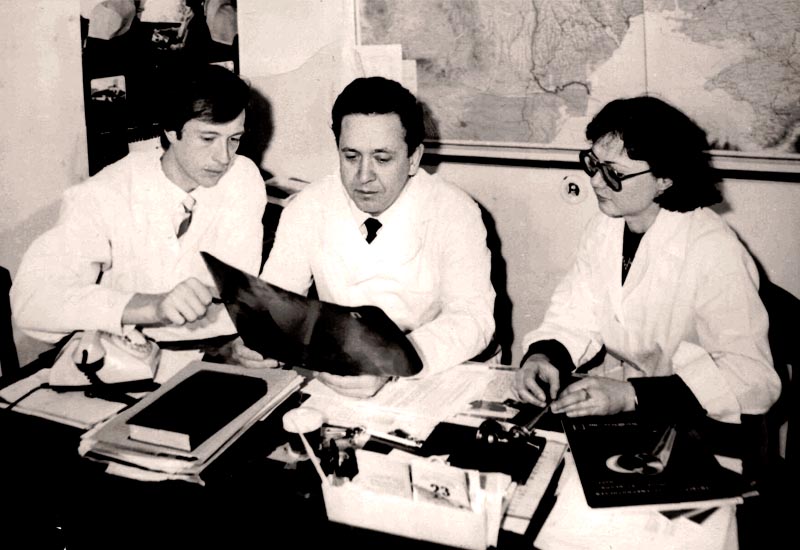 The programme involved the Ministries of Health, Internal Affairs, and Communications of Ukraine, the Traffic Police, the Ukrainian Scientific Research Institute of Traumatology and Orthopaedics (Kyiv), the Research Institutes of Neurosurgery, Emergency Surgery, and almost all departments of orthopaedics and traumatology in Ukraine. Thanks to the targeted work of the department’s staff, in 1983, Ukraine conducted its first field experiment on the organisation of emergency medical care for the injured with the involvement of the traffic police helicopters (fig. 14).

 As a result of the comprehensive work carried out, a first aid instruction for road traffic injuries was issued, along with a number of methodological recommendations and a joint order from the Ministry of Internal Affairs and the Ministry of Health of Ukraine on the organisation and provision of road safety.
In April 1985, the organisational-methodological department was reorganised into the Laboratory of Social-Hygienic Research and Injury Prevention, but continued its organisational-methodological activities. From 1986 to 1989, the laboratory scientists conducted research on the medico-social and organisational aspects of trauma in workers and employees of the Ministry of Industrial Construction of the USSR. The state of trauma and the organisation of trauma care at 11 large construction complexes was studied, and the causes and social factors of injuries in construction were analysed. Based on the results of the study, methodological recommendations and a practical guide were issued.
As a result of the comprehensive work carried out, a first aid instruction for road traffic injuries was issued, along with a number of methodological recommendations and a joint order from the Ministry of Internal Affairs and the Ministry of Health of Ukraine on the organisation and provision of road safety.
In April 1985, the organisational-methodological department was reorganised into the Laboratory of Social-Hygienic Research and Injury Prevention, but continued its organisational-methodological activities. From 1986 to 1989, the laboratory scientists conducted research on the medico-social and organisational aspects of trauma in workers and employees of the Ministry of Industrial Construction of the USSR. The state of trauma and the organisation of trauma care at 11 large construction complexes was studied, and the causes and social factors of injuries in construction were analysed. Based on the results of the study, methodological recommendations and a practical guide were issued.


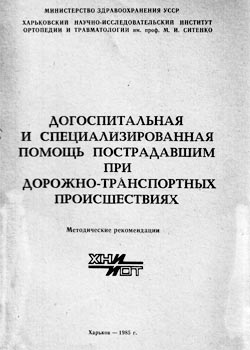

 The introduction of the recommendations developed at the institute into the practice of construction organisations allowed for a reduction in the frequency and severity of occupational injuries to the musculoskeletal system and improved the quality of providing first aid and pre-hospital trauma care to the injured.
In July 1992, the Laboratory of Social-Hygienic Research was reorganised and renamed the Scientific-Organisational Department (SOD). The head of the department, Prof. D.O. Yaremenko, and senior researcher O.H. Shevchenko developed a concept for the further development of the institute’s scientific-organisational and methodological activities in the new socio-economic conditions in the following areas: scientific research, scientific-organisational, organisational-methodological activities, and training scientific and practical personnel in orthopaedics and traumatology. According to the concept, the main areas of the department’s scientific-organisational and methodological work were defined as follows:
The introduction of the recommendations developed at the institute into the practice of construction organisations allowed for a reduction in the frequency and severity of occupational injuries to the musculoskeletal system and improved the quality of providing first aid and pre-hospital trauma care to the injured.
In July 1992, the Laboratory of Social-Hygienic Research was reorganised and renamed the Scientific-Organisational Department (SOD). The head of the department, Prof. D.O. Yaremenko, and senior researcher O.H. Shevchenko developed a concept for the further development of the institute’s scientific-organisational and methodological activities in the new socio-economic conditions in the following areas: scientific research, scientific-organisational, organisational-methodological activities, and training scientific and practical personnel in orthopaedics and traumatology. According to the concept, the main areas of the department’s scientific-organisational and methodological work were defined as follows:
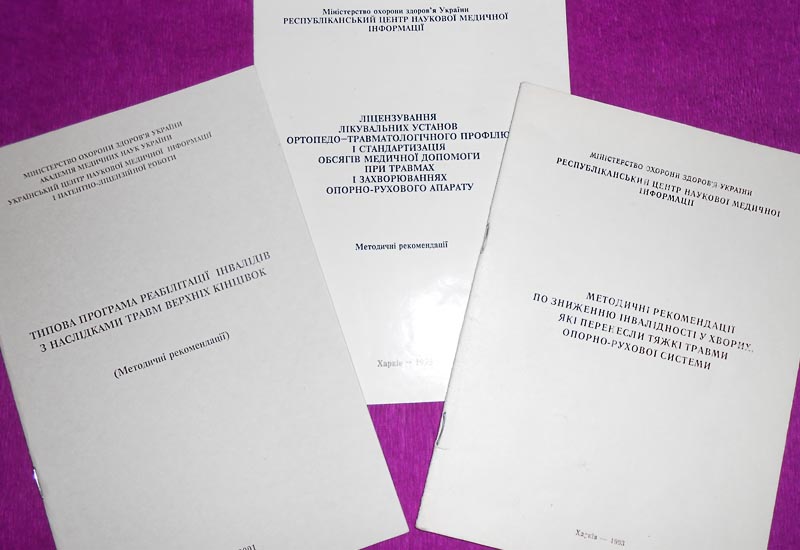 In 1995-2000, researchers from the department conducted a study on disability caused by injuries and, for the first time, by diseases of the upper limbs. For the first time, the dynamics of disability due to the mentioned pathology were defined depending on the implementation of medical rehabilitation and dispensary monitoring. The study identified the features of employment for individuals with persistent upper limb dysfunction and for the first time established the leading factors that determine the actual results of professional rehabilitation depending on the type of pathology. A typical rehabilitation program for individuals with the consequences of injuries and orthopedic diseases of the upper limbs was developed for the first time.
In accordance with the directive of the Cabinet of Ministers of Ukraine from November 18, 1996, No. 21856/46, the Sytenko Institute of Spine and Joint Pathology National Academy of Medical Sciences of Ukraine participated in the execution of an intergovernmental comprehensive medical-social health and rehabilitation program for internationalist soldiers and their families. Department staff studied the contingent of internationalist soldiers in the Kharkiv region and analysed the frequency and nature of orthopedic-traumatological pathology caused by gunshot and mine-explosive injuries, developing scientifically grounded recommendations for improving the organisation of health and rehabilitation of internationalist soldiers. The implementation of these recommendations in practice allowed for the optimisation of conditions for the physical and social adaptation of internationalist soldiers.
In 2001-2003, department staff studied disability caused by orthopedic pathology in children under state care in orphanages and state educational institutions for orphans and children deprived of parental care. Within this work, mass screenings of children in 6 orphanages and boarding schools in the Kharkiv region were conducted, and the state of medical-social rehabilitation, vocational and labour orientation, and further employment of the children from these institutions was studied and analysed in detail. As a result of this work, recommendations were developed to improve the medical-professional rehabilitation of children under state care in educational institutions.
During the same years, the department conducted a comprehensive analysis of road traffic injuries and the level of medical assistance organisation for road traffic accident victims in Ukraine. Taking into account causal relationships, the main causes of disability and mortality resulting from road traffic injuries were identified. For the first time, a reliable inverse correlation was found between the mortality rate among road traffic accident victims and the level of urbanisation in Ukrainian regions, which is one of the direct proofs of shortcomings in the organisation of medical assistance for accident victims in rural areas. Based on the obtained data and causal relationships, a set of measures for the prevention and reduction of mortality and disability due to road traffic injuries was developed, and a concept for modern medical assistance organisation in the pre-hospital stage for road traffic accident victims was formulated, along with an action algorithm for road users and accident witnesses, and an algorithmic scheme for providing medical assistance at the pre-hospital stage to victims of road traffic accidents.
In 2004-2012, the primary focus of the researchers in the scientific-organisational department was on disability due to spine and joint diseases, including degenerative spine diseases, osteoarthritis of large joints, and inflammatory arthropathies. For the first time, the medical-social factors playing a leading role in the formation of primary disability due to these pathologies were identified, the dynamics of disability for each of the nosological forms were studied, including for the first time, depending on the type and nature of the treatment provided in terms of medical rehabilitation. For the first time, the rehabilitation potential and prognosis in disabled individuals with these pathologies were determined based on the severity of pathological changes, the nature of medical rehabilitation measures considering age, professional occupation, and criteria for life activity limitations. As a result of the research, untapped reserves for solving the problem of reducing disability rates and increasing rehabilitation effectiveness for each of the aforementioned pathologies were identified, key principles for organising medical rehabilitation were formulated, and scientifically grounded recommendations were developed to prevent disability and improve the organisation and effectiveness of treatment and rehabilitation for patients and disabled individuals.
In 2013-2015, department staff studied the state and medical-organisational aspects of rehabilitation for disabled children with spine pathology. For the first time in Ukraine, the structure of disability due to spine pathology among the child population was highlighted, the degree of functional impairments was determined, and the criteria for life activity limitations of children due to vertebral pathology were analysed according to the International Classification of Functioning, Disability, and Health. Based on the results of the research on the rehabilitation of disabled children with spine pathology, the department’s researchers developed a method for comprehensive assessment of anatomical-functional impairments in children with spine pathology, for which a utility model patent No. 97375 was obtained.
The results of the research on the medical-organisational aspects of rehabilitation for individuals with the consequences of injuries and diseases of the musculoskeletal system, conducted by staff from the scientific-organisational department over two decades, were summarised in a collection of scientific works edited by Prof. M. Korzh and Prof. D. Yaremenko.
In 1995-2000, researchers from the department conducted a study on disability caused by injuries and, for the first time, by diseases of the upper limbs. For the first time, the dynamics of disability due to the mentioned pathology were defined depending on the implementation of medical rehabilitation and dispensary monitoring. The study identified the features of employment for individuals with persistent upper limb dysfunction and for the first time established the leading factors that determine the actual results of professional rehabilitation depending on the type of pathology. A typical rehabilitation program for individuals with the consequences of injuries and orthopedic diseases of the upper limbs was developed for the first time.
In accordance with the directive of the Cabinet of Ministers of Ukraine from November 18, 1996, No. 21856/46, the Sytenko Institute of Spine and Joint Pathology National Academy of Medical Sciences of Ukraine participated in the execution of an intergovernmental comprehensive medical-social health and rehabilitation program for internationalist soldiers and their families. Department staff studied the contingent of internationalist soldiers in the Kharkiv region and analysed the frequency and nature of orthopedic-traumatological pathology caused by gunshot and mine-explosive injuries, developing scientifically grounded recommendations for improving the organisation of health and rehabilitation of internationalist soldiers. The implementation of these recommendations in practice allowed for the optimisation of conditions for the physical and social adaptation of internationalist soldiers.
In 2001-2003, department staff studied disability caused by orthopedic pathology in children under state care in orphanages and state educational institutions for orphans and children deprived of parental care. Within this work, mass screenings of children in 6 orphanages and boarding schools in the Kharkiv region were conducted, and the state of medical-social rehabilitation, vocational and labour orientation, and further employment of the children from these institutions was studied and analysed in detail. As a result of this work, recommendations were developed to improve the medical-professional rehabilitation of children under state care in educational institutions.
During the same years, the department conducted a comprehensive analysis of road traffic injuries and the level of medical assistance organisation for road traffic accident victims in Ukraine. Taking into account causal relationships, the main causes of disability and mortality resulting from road traffic injuries were identified. For the first time, a reliable inverse correlation was found between the mortality rate among road traffic accident victims and the level of urbanisation in Ukrainian regions, which is one of the direct proofs of shortcomings in the organisation of medical assistance for accident victims in rural areas. Based on the obtained data and causal relationships, a set of measures for the prevention and reduction of mortality and disability due to road traffic injuries was developed, and a concept for modern medical assistance organisation in the pre-hospital stage for road traffic accident victims was formulated, along with an action algorithm for road users and accident witnesses, and an algorithmic scheme for providing medical assistance at the pre-hospital stage to victims of road traffic accidents.
In 2004-2012, the primary focus of the researchers in the scientific-organisational department was on disability due to spine and joint diseases, including degenerative spine diseases, osteoarthritis of large joints, and inflammatory arthropathies. For the first time, the medical-social factors playing a leading role in the formation of primary disability due to these pathologies were identified, the dynamics of disability for each of the nosological forms were studied, including for the first time, depending on the type and nature of the treatment provided in terms of medical rehabilitation. For the first time, the rehabilitation potential and prognosis in disabled individuals with these pathologies were determined based on the severity of pathological changes, the nature of medical rehabilitation measures considering age, professional occupation, and criteria for life activity limitations. As a result of the research, untapped reserves for solving the problem of reducing disability rates and increasing rehabilitation effectiveness for each of the aforementioned pathologies were identified, key principles for organising medical rehabilitation were formulated, and scientifically grounded recommendations were developed to prevent disability and improve the organisation and effectiveness of treatment and rehabilitation for patients and disabled individuals.
In 2013-2015, department staff studied the state and medical-organisational aspects of rehabilitation for disabled children with spine pathology. For the first time in Ukraine, the structure of disability due to spine pathology among the child population was highlighted, the degree of functional impairments was determined, and the criteria for life activity limitations of children due to vertebral pathology were analysed according to the International Classification of Functioning, Disability, and Health. Based on the results of the research on the rehabilitation of disabled children with spine pathology, the department’s researchers developed a method for comprehensive assessment of anatomical-functional impairments in children with spine pathology, for which a utility model patent No. 97375 was obtained.
The results of the research on the medical-organisational aspects of rehabilitation for individuals with the consequences of injuries and diseases of the musculoskeletal system, conducted by staff from the scientific-organisational department over two decades, were summarised in a collection of scientific works edited by Prof. M. Korzh and Prof. D. Yaremenko.
 Today, the department is working on the most relevant topic, such as the medico-organisational aspects of the rehabilitation of those affected by the consequences of gunshot, mine-explosive, and shrapnel injuries to the spine and joints.
The Scientific and Organisational Department has always worked closely with the Kharkiv regional and city health authorities, the Kharkiv Regional Centre for Medical and Social Expertise, the interdistrict trauma MSEC, and healthcare institutions. The recommendations developed in the department to improve the quality and organisation of medical care for patients with the consequences of injuries and diseases of the musculoskeletal system are reflected in the decisions and orders of the Health Department and the Kharkiv Regional Centre for Medical and Social Expertise.
By order of the Ministry of Health of Ukraine, the department staff actively participated in preparing scientifically grounded proposals regarding the regulation of the specialised orthopaedic-traumatology service in the country, which were later used in drafting the corresponding order of the Ministry of Health of Ukraine No. 41 dated 30.03.1994. In 2009, projects of two new orders of the Ministry of Health of Ukraine were prepared concerning the regulation of the state orthopaedic-traumatology service for children and adults, taking into account modern requirements for healthcare institutions and the system of medical assistance provision.
To ensure the institute’s innovative activity, department staff conduct documentation-methodical support for publications in the innovation registry, publish methodical recommendations, information leaflets, and other publications related to the institute’s new developments and achievements.
An important part of the work of the Scientific and Organisational Department is the organisation and provision of methodological assistance with the curating of regions of Ukraine on the provision of medical care to patients with spine and joint pathologies, as well as curating issues related to specialised orthopaedic-traumatology assistance in 8 regions of the country assigned to the institute. The department staff has developed standard functional duties for curators, prepares schedules for their visits to assigned regions each year, and prepares individual assignments and draft agreements on joint activities with regional authorities and institutions.
Since 2014, the department has coordinated the work of sending specialists from the institute as part of the teams of the North-East Scientific Centre of the Ministry of Health and the National Academy of Medical Sciences of Ukraine to district hospitals under cooperation agreements with district state administrations of Kharkiv region.
The department staff organises scientific events: seminars, scientific-practical conferences, symposiums, congresses, and meetings, where the institute’s scientific achievements are promoted to a wide range of specialists. In 2007, the Institute celebrated its 100th anniversary and held an international conference on topical issues in orthopaedics and traumatology. Approximately 500 leading specialists in orthopaedics and traumatology, neurosurgeons, neurologists, physiotherapists, biologists, material scientists, and engineers participated in the conference. The conference defined new key strategic directions for fundamental and applied research in orthopaedics and traumatology.
The institute has held four congresses of orthopaedic-traumatologists of Ukraine: IV, VII, XI, XVI. The XVI congress was held in Kharkiv from 3-5 October 2013, with 602 specialists from Ukraine, Belarus, Russia, Uzbekistan, Azerbaijan, Slovenia, Germany, France, and Poland participating.
Every year, for 15 years, the institute, in collaboration with the International Society of Minimally Invasive and Instrumental Spine Surgery (ISMISS), has held a symposium on spinal pathology issues in Kharkiv, which is attended by leading vertebrologists from around the world, confirming the high authority of the Kharkiv school of orthopaedics and traumatology.
The solution to the problems of prevention and reduction of mortality and disability from injuries, as well as the reduction of disability periods for diseases of the musculoskeletal system, is possible through the implementation of highly effective technologies and modern treatment methods. An important factor in this is the individual skills of the doctor.
The organisation and methodological support of training through doctoral studies, postgraduate studies, clinical residency, as well as in the form of internships and courses for professional development, have become one of the most important directions of the department’s work since its establishment in 1929. Training activities became particularly active in the post-war years, starting from 1945.
From 1945 to 2017, 113 specialists were trained in full-time and part-time postgraduate studies, 135 in clinical residency, 1356 doctors and 376 medical professionals in professional development courses (since 1982 replaced with continuously operating information and internship courses), and 7720 specialists in thematic seminars and master classes on current issues in orthopaedics and traumatology. 703 doctors and 172 mid-level medical workers completed internships at the institute’s clinics during this period.
Most of the doctors who studied in postgraduate studies successfully defended their candidate’s theses, and 15 specialists later defended doctoral theses.
Since 1978, the institute has been training foreign doctors in full-time postgraduate studies, clinical residency, and in the form of internships (1978-1991 – through WHO bilateral agreements, from 1991 – through contracts). During this time, 29 foreign specialists from far-abroad countries were trained, and now they promote the developments and achievements of the Kharkiv orthopaedic school in their home countries (Egypt, Hungary, Yemen, Jordan, Syria, India, Bangladesh, Lebanon, Ghana, Tanzania, Palestine, Iraq, China, Sudan, Indonesia).
Today, the department is working on the most relevant topic, such as the medico-organisational aspects of the rehabilitation of those affected by the consequences of gunshot, mine-explosive, and shrapnel injuries to the spine and joints.
The Scientific and Organisational Department has always worked closely with the Kharkiv regional and city health authorities, the Kharkiv Regional Centre for Medical and Social Expertise, the interdistrict trauma MSEC, and healthcare institutions. The recommendations developed in the department to improve the quality and organisation of medical care for patients with the consequences of injuries and diseases of the musculoskeletal system are reflected in the decisions and orders of the Health Department and the Kharkiv Regional Centre for Medical and Social Expertise.
By order of the Ministry of Health of Ukraine, the department staff actively participated in preparing scientifically grounded proposals regarding the regulation of the specialised orthopaedic-traumatology service in the country, which were later used in drafting the corresponding order of the Ministry of Health of Ukraine No. 41 dated 30.03.1994. In 2009, projects of two new orders of the Ministry of Health of Ukraine were prepared concerning the regulation of the state orthopaedic-traumatology service for children and adults, taking into account modern requirements for healthcare institutions and the system of medical assistance provision.
To ensure the institute’s innovative activity, department staff conduct documentation-methodical support for publications in the innovation registry, publish methodical recommendations, information leaflets, and other publications related to the institute’s new developments and achievements.
An important part of the work of the Scientific and Organisational Department is the organisation and provision of methodological assistance with the curating of regions of Ukraine on the provision of medical care to patients with spine and joint pathologies, as well as curating issues related to specialised orthopaedic-traumatology assistance in 8 regions of the country assigned to the institute. The department staff has developed standard functional duties for curators, prepares schedules for their visits to assigned regions each year, and prepares individual assignments and draft agreements on joint activities with regional authorities and institutions.
Since 2014, the department has coordinated the work of sending specialists from the institute as part of the teams of the North-East Scientific Centre of the Ministry of Health and the National Academy of Medical Sciences of Ukraine to district hospitals under cooperation agreements with district state administrations of Kharkiv region.
The department staff organises scientific events: seminars, scientific-practical conferences, symposiums, congresses, and meetings, where the institute’s scientific achievements are promoted to a wide range of specialists. In 2007, the Institute celebrated its 100th anniversary and held an international conference on topical issues in orthopaedics and traumatology. Approximately 500 leading specialists in orthopaedics and traumatology, neurosurgeons, neurologists, physiotherapists, biologists, material scientists, and engineers participated in the conference. The conference defined new key strategic directions for fundamental and applied research in orthopaedics and traumatology.
The institute has held four congresses of orthopaedic-traumatologists of Ukraine: IV, VII, XI, XVI. The XVI congress was held in Kharkiv from 3-5 October 2013, with 602 specialists from Ukraine, Belarus, Russia, Uzbekistan, Azerbaijan, Slovenia, Germany, France, and Poland participating.
Every year, for 15 years, the institute, in collaboration with the International Society of Minimally Invasive and Instrumental Spine Surgery (ISMISS), has held a symposium on spinal pathology issues in Kharkiv, which is attended by leading vertebrologists from around the world, confirming the high authority of the Kharkiv school of orthopaedics and traumatology.
The solution to the problems of prevention and reduction of mortality and disability from injuries, as well as the reduction of disability periods for diseases of the musculoskeletal system, is possible through the implementation of highly effective technologies and modern treatment methods. An important factor in this is the individual skills of the doctor.
The organisation and methodological support of training through doctoral studies, postgraduate studies, clinical residency, as well as in the form of internships and courses for professional development, have become one of the most important directions of the department’s work since its establishment in 1929. Training activities became particularly active in the post-war years, starting from 1945.
From 1945 to 2017, 113 specialists were trained in full-time and part-time postgraduate studies, 135 in clinical residency, 1356 doctors and 376 medical professionals in professional development courses (since 1982 replaced with continuously operating information and internship courses), and 7720 specialists in thematic seminars and master classes on current issues in orthopaedics and traumatology. 703 doctors and 172 mid-level medical workers completed internships at the institute’s clinics during this period.
Most of the doctors who studied in postgraduate studies successfully defended their candidate’s theses, and 15 specialists later defended doctoral theses.
Since 1978, the institute has been training foreign doctors in full-time postgraduate studies, clinical residency, and in the form of internships (1978-1991 – through WHO bilateral agreements, from 1991 – through contracts). During this time, 29 foreign specialists from far-abroad countries were trained, and now they promote the developments and achievements of the Kharkiv orthopaedic school in their home countries (Egypt, Hungary, Yemen, Jordan, Syria, India, Bangladesh, Lebanon, Ghana, Tanzania, Palestine, Iraq, China, Sudan, Indonesia).
 Information and internship courses, as well as the opportunity for experience exchange at the workplace, continue to be very popular among doctors from other countries even after Ukraine gained independence: from 1991 to 2017, 178 doctors from Latvia, Lebanon, Tanzania, Jordan, Egypt, Syria, Libya, Georgia, Moldova, Belarus, Russia, Kazakhstan, Uzbekistan, Azerbaijan, and Turkmenistan completed professional development courses and underwent training in the form of internships at the workplace.
Thanks to the successful work of the department staff, the institute was one of the first in the National Academy of Medical Sciences to receive licences from the Ministry of Education and Science of Ukraine for conducting educational activities for the professional development of specialists, including foreign citizens, as well as for carrying out educational activities at the third educational-scientific level of higher education to prepare doctoral candidates in postgraduate studies.
The staff of the Scientific and Organisational Department, in collaboration with the Board of the Kharkiv Regional Branch of the Public Organisation “Ukrainian Association of Orthopaedic-Traumatologists”, organise and conduct the “Orthopaedist-Traumatologist Days” almost every month, where current issues in orthopaedics and traumatology, as well as complex cases from medical practice, are discussed.
Information and internship courses, as well as the opportunity for experience exchange at the workplace, continue to be very popular among doctors from other countries even after Ukraine gained independence: from 1991 to 2017, 178 doctors from Latvia, Lebanon, Tanzania, Jordan, Egypt, Syria, Libya, Georgia, Moldova, Belarus, Russia, Kazakhstan, Uzbekistan, Azerbaijan, and Turkmenistan completed professional development courses and underwent training in the form of internships at the workplace.
Thanks to the successful work of the department staff, the institute was one of the first in the National Academy of Medical Sciences to receive licences from the Ministry of Education and Science of Ukraine for conducting educational activities for the professional development of specialists, including foreign citizens, as well as for carrying out educational activities at the third educational-scientific level of higher education to prepare doctoral candidates in postgraduate studies.
The staff of the Scientific and Organisational Department, in collaboration with the Board of the Kharkiv Regional Branch of the Public Organisation “Ukrainian Association of Orthopaedic-Traumatologists”, organise and conduct the “Orthopaedist-Traumatologist Days” almost every month, where current issues in orthopaedics and traumatology, as well as complex cases from medical practice, are discussed.


 Such events contribute to the exchange of experience and the improvement of doctors’ qualifications.
The Scientific and Organisational Department of the Sytenko Institute of Spine and Joint Pathology National Academy of Medical Sciences of Ukraine has always kept its finger on the pulse of socio-economic and legislative changes in the country. Continuing the traditions of the Sytenko school of orthopaedic-traumatologists, the department staff carries out consistent scientific-organisational and organisational-methodological work, making every effort to address current issues regarding the quality of orthopaedic-traumatological care for the population, strengthening the human resources and scientific potential of orthopaedics and traumatology, and fostering new scientists in orthopaedic-traumatology.
The global prestige and authority of the Sytenko Institute of Spine and Joint Pathology National Academy of Medical Sciences of Ukraine and the Kharkiv scientific school of orthopaedic-traumatologists are largely determined by the organisational-methodological focus of its multifaceted scientific, clinical, and medical work.
Such events contribute to the exchange of experience and the improvement of doctors’ qualifications.
The Scientific and Organisational Department of the Sytenko Institute of Spine and Joint Pathology National Academy of Medical Sciences of Ukraine has always kept its finger on the pulse of socio-economic and legislative changes in the country. Continuing the traditions of the Sytenko school of orthopaedic-traumatologists, the department staff carries out consistent scientific-organisational and organisational-methodological work, making every effort to address current issues regarding the quality of orthopaedic-traumatological care for the population, strengthening the human resources and scientific potential of orthopaedics and traumatology, and fostering new scientists in orthopaedic-traumatology.
The global prestige and authority of the Sytenko Institute of Spine and Joint Pathology National Academy of Medical Sciences of Ukraine and the Kharkiv scientific school of orthopaedic-traumatologists are largely determined by the organisational-methodological focus of its multifaceted scientific, clinical, and medical work.
K. Ostapko, Head of the Department of Periphery, Social Hygiene, and Personnel (1929–1941)
PhD F. Eliashberh, Head of the Organizational and Methodological Department (1946–1954)
PhD A. Kravchenko, Head of the Organizational and Methodological Department (1954–1964)
PhD H. Itskova, Head of the Organizational and Methodological Department (1964–1972)
DMSc H. Fadeiev, Head of the Organizational and Methodological Department (1972–1977)
DMSc V. Berdnikov, Head of the Organizational and Methodological Department (1977–1982)
M. Hurianova, Head of the Organizational and Methodological Department (1982–1985)
PhD V. Krupenia, Head of the Laboratory of Social Hygiene and Injury Prevention (1985–1991)
Prof. D. Yaremenko, Head of the Scientific and Organizational Department (1991–2006)
DMSc O. Korolkov, Head of the Scientific and Organizational Department (2006–2018)
Professor Volodymyr Tankut, Head of the Scientific and Organizational Department (since 2018)
PhD H.V. Bezvesylna
DMSc V.S. Kostrykov
DMSc H.M. Sokol
PhD V.B. Tarshys
DMSc V.Ya. Moskin
Prof. V.O. Tankut
PhD T.M. Hrashchenkova
Assoc. Prof. I.I. Ryzhykov
The department’s tasks since its inception have been the scientific justification for the organisation and development of specialised orthopaedic and trauma care for the country’s population, the organisation of training qualified personnel in orthopaedics and traumatology, and providing organisational and methodological assistance to administrative territorial health authorities and medical institutions. Since then, all the institute’s scientific, organisational, and methodological work has been conducted with the direct participation of the department.
To achieve these objectives, it was necessary to obtain data on the prevalence, level, and overall structure of injuries and orthopaedic diseases, as well as the population’s need for specialised care. To study the prevalence of orthopaedic diseases, the state of occupational injuries, and the organisation of medical care, the department conducted sample studies in outpatient clinics and hospitals in the Artemivsk district of Donbas, Kryvyi Rih, Luhansk, and Poltava regions between 1929 and 1931. The first expedition, led by M. P. Novachenko, was sent to the Artemivsk district of Donbas in 1929 to study the organisation of medical care at coal industry enterprises. The prevalence of orthopaedic diseases and the level of injuries in agricultural regions were studied in the Dykan district of the Poltava region during a research expedition led by V. O. Marks in the summer of 1929. In February 1931, under the leadership of B. S. Havrylenko, the network of medical institutions and the state of trauma care for workers at iron and manganese mining enterprises in Kryvyi Rih and Nikopol-Marganets were examined. In the summer of 1931, V. D. Chaklin led a similar study of industrial enterprises, including coal mines, in the Luhansk region. Based on the obtained data, types of orthopaedic and trauma institutions were developed, along with guidelines on their material support and technical equipment, the nature of their work, and the system for providing specialised orthopaedic and trauma care to injured and sick individuals, as well as the norms for orthopaedic and trauma services and specialised medical assistance for the population.
In 1932, in close cooperation with territorial health management authorities, the department began implementing a scientifically grounded set of measures to establish a network of orthopaedic and trauma institutions in Left-Bank Ukraine, whose practical activities were closely linked to the institute’s research work. The institute became the leading centre for organising, planning, and directing the activities of the entire network of orthopaedic and trauma institutions. The Peripheral, Social Hygiene, and Personnel Department played a key role in this work.
In 1934, the People’s Commissariat of Health determined the spheres of influence of the Kyiv and Kharkiv institutes of orthopaedics and traumatology. The Ukrainian State Clinical Institute of Orthopaedics and Traumatology, located in Kharkiv, was assigned the Left-Bank Ukraine regions, where work continued on establishing and developing the outpatient and inpatient network of the specialised service. As a result, by 1937, 34 peripheral specialised departments with a total of more than two thousand beds were operating in the industrial centres and agricultural regions of Left-Bank Ukraine. The institute opened 27 scientific reference points (SRPs) based on these facilities, increasing to 29 by the end of 1940.
In 1934, an Institute for the Rehabilitation of Traumatized Workers was opened in Sloviansk based on an SRP, where medical rehabilitation and follow-up monitoring of orthopaedic and trauma patients requiring sanatorium-resort treatment were conducted according to the methods of the Institute of Orthopaedics and Traumatology.
Qualified personnel were needed for the specialised departments and SRPs. In the late 1920s, the department organised training for intern doctors at the institute in diagnostic and treatment methods for patients with musculoskeletal system disorders, postgraduate training in orthopaedics and traumatology, and courses for training mid-level medical personnel in plaster techniques. Additionally, short-term courses and seminars were held for doctors on current issues in orthopaedics and traumatology.
Since 1931, regular cyclic (thematic) courses for improving the qualifications of orthopaedic and trauma doctors had been organised. In the late 1930s, a higher form of qualification improvement was introduced—a clinical residency in the speciality of “Orthopaedics and Traumatology.”
From the early years of the department’s establishment, research on injury prevention and the organisation of medical care for the injured played a crucial role in its activities. By the late 1930s, the department had organised courses to train drivers, tram operators, and police officers in providing first aid to accident victims. Additionally, the institute successfully advocated for the People’s Commissariat of Education to include road safety lessons in school curricula and developed special training courses for teachers on street traffic studies and first aid for accident victims. Ambulances were equipped with standard splints developed by the institute. To improve the quality of specialised care for injured miners, principles for primary medical assistance in mine injuries were developed, along with regulations for the medical and material-technical equipment of underground trauma points.
The Great Patriotic War disrupted the development and improvement of the orthopaedic and trauma care system in the country. After the war, the institute had to restore the previously existing orthopaedic and trauma service. To study the war’s sanitary consequences and assess the state of institutions providing specialised care, expeditions and team inspections were organised. In the summer of 1946, the second expedition, led by H. M. Baturina, was sent to the Dykan district of the Poltava region. Based on the data obtained on the structure and dynamics of orthopaedic pathology, disabling factors, and the state of orthopaedic and trauma care, measures were developed to provide specialised medical assistance to patients in need.
Organisational and methodological issues regarding the restoration of orthopaedic-traumatological care were discussed and resolved at conferences held by the department. By the late 1950s, there were already 40 scientific support points in the regions attached to the institute, which actively worked on the restoration of a network of specialised orthopaedic-traumatological institutions. The organisational-methodological department maintained communication with the support points and the periphery by organising periodic planned trips for institute staff to the locations, calling doctors to the institute, and convening special conferences for scientific support points. Between 1944 and 1957, the organisational-methodological department organised 652 trips for institute staff to peripheral medical institutions to provide methodological, organisational, and medical assistance. A significant contribution to restoring the normal operation of the orthopaedic-traumatological service was made by holding 17 scientific conferences and 5 interregional conferences for medical institutions for war invalids.
Soon, many scientific support points reached such a scientific, practical, and organisational level that they no longer required guidance from the institute. On their basis, the Donetsk Scientific Research Institute of Traumatology and Orthopaedics, departments at medical higher educational institutions in Donetsk, Simferopol, Zaporizhzhia, Luhansk, and Poltava were established.
In the post-war period, social-hygienic studies on the issues of trauma and orthopaedic morbidity were restored at the institute, which were conducted at the initiative and with the direct participation of the staff of the organisational-methodological department.
In 1956, the first trip of a medical team was organised to the virgin lands of the North Kazakhstan and Kokshetau regions to study the state of trauma care and provide practical assistance. In the following 8 years, every year, during the harvesting season, a team of specialists from the institute (V.S. Kostrikov, V.Ya. Moskin, V.P. Pelypenko, S.D. Shevchenko and medical nurses), provided not only consultative and medical, but also organisational-methodological assistance to medical institutions and health authorities in the districts and cities of Kazakhstan. As a result of this work, the first publication in the USSR, co-authored with TsITO, by V.S. Kostrikov and O.M. Morozova, was released, addressing issues of trauma in the virgin lands. In 1961, the third expedition of institute staff took place in the Dykansky district of Poltava region.
As a result of the expedition, a set of measures for the development of specialised orthopaedic-traumatological care for rural populations was developed, recommended by the Ministry of Health of the Ukrainian SSR for implementation in practice.
In the 1970s, the prevalence of musculoskeletal system injuries among various population groups was studied, the organisation of prosthetic care for disabled children was improved, and measures were developed to improve the organisation of rehabilitation for patients with the consequences of injuries and diseases of the musculoskeletal system, who work in various sectors of the economy.
In 1973, a team of 7 institute specialists, led by PhD G.P. Itskova and D.O. Yaremenko, was organised for a trip to the Kharkiv Motor Building Plant “Serp i Molot”. The purpose of this work was to analyse trauma, identify the impact of working conditions on the occurrence and development of orthopaedic diseases, and develop and implement comprehensive measures to prevent serious consequences of injuries and musculoskeletal diseases among the workers of the enterprise.
In 1979, considering the significant experience of the institute in the prevention of industrial, street, and road traffic trauma, a decision by the Council of Ministers of the Ukrainian SSR and the Ministry of Health of Ukraine established the Republican Organisational-Methodological Centre for the Prevention of Road and Domestic Trauma at the institute. In connection with this, from 1980 to 1985, the institute, as the main coordinating centre, led the implementation of the Republican State Program for the Fight Against Road Traffic Trauma. To ensure the work of this programme, a special road traffic group was created within the organisational-methodological department.
The programme involved the Ministries of Health, Internal Affairs, and Communications of Ukraine, the Traffic Police, the Ukrainian Scientific Research Institute of Traumatology and Orthopaedics (Kyiv), the Research Institutes of Neurosurgery, Emergency Surgery, and almost all departments of orthopaedics and traumatology in Ukraine. Thanks to the targeted work of the department’s staff, in 1983, Ukraine conducted its first field experiment on the organisation of emergency medical care for the injured with the involvement of the traffic police helicopters (fig. 14).
As a result of the comprehensive work carried out, a first aid instruction for road traffic injuries was issued, along with a number of methodological recommendations and a joint order from the Ministry of Internal Affairs and the Ministry of Health of Ukraine on the organisation and provision of road safety.
In April 1985, the organisational-methodological department was reorganised into the Laboratory of Social-Hygienic Research and Injury Prevention, but continued its organisational-methodological activities. From 1986 to 1989, the laboratory scientists conducted research on the medico-social and organisational aspects of trauma in workers and employees of the Ministry of Industrial Construction of the USSR. The state of trauma and the organisation of trauma care at 11 large construction complexes was studied, and the causes and social factors of injuries in construction were analysed. Based on the results of the study, methodological recommendations and a practical guide were issued.
- Research on the medico-social problems of disability resulting from injuries and orthopaedic diseases of the musculoskeletal system, justification and development of medical and organisational measures for its prevention;
- Improvement of the organisation and provision of first medical and specialised assistance to the population and medical rehabilitation for disabled people;
- Implementation of the institute’s developments in the practice of healthcare institutions and the authors’ supervision of the innovation process;
- Preparation and organisation of congresses, scientific conferences, symposiums, seminars, and meetings at the institute;
- Training scientific and scientific-pedagogical personnel in the field of orthopaedics and traumatology through doctoral and postgraduate studies, increasing the qualifications of orthopaedic-traumatologist doctors (clinical residency, information and internship courses, workplace internship), increasing the qualifications of middle-level workers (information and internship courses, workplace internship), internship for medical interns for primary specialisation in orthopaedics and traumatology.
In 1995-2000, researchers from the department conducted a study on disability caused by injuries and, for the first time, by diseases of the upper limbs. For the first time, the dynamics of disability due to the mentioned pathology were defined depending on the implementation of medical rehabilitation and dispensary monitoring. The study identified the features of employment for individuals with persistent upper limb dysfunction and for the first time established the leading factors that determine the actual results of professional rehabilitation depending on the type of pathology. A typical rehabilitation program for individuals with the consequences of injuries and orthopedic diseases of the upper limbs was developed for the first time.
In accordance with the directive of the Cabinet of Ministers of Ukraine from November 18, 1996, No. 21856/46, the Sytenko Institute of Spine and Joint Pathology National Academy of Medical Sciences of Ukraine participated in the execution of an intergovernmental comprehensive medical-social health and rehabilitation program for internationalist soldiers and their families. Department staff studied the contingent of internationalist soldiers in the Kharkiv region and analysed the frequency and nature of orthopedic-traumatological pathology caused by gunshot and mine-explosive injuries, developing scientifically grounded recommendations for improving the organisation of health and rehabilitation of internationalist soldiers. The implementation of these recommendations in practice allowed for the optimisation of conditions for the physical and social adaptation of internationalist soldiers.
In 2001-2003, department staff studied disability caused by orthopedic pathology in children under state care in orphanages and state educational institutions for orphans and children deprived of parental care. Within this work, mass screenings of children in 6 orphanages and boarding schools in the Kharkiv region were conducted, and the state of medical-social rehabilitation, vocational and labour orientation, and further employment of the children from these institutions was studied and analysed in detail. As a result of this work, recommendations were developed to improve the medical-professional rehabilitation of children under state care in educational institutions.
During the same years, the department conducted a comprehensive analysis of road traffic injuries and the level of medical assistance organisation for road traffic accident victims in Ukraine. Taking into account causal relationships, the main causes of disability and mortality resulting from road traffic injuries were identified. For the first time, a reliable inverse correlation was found between the mortality rate among road traffic accident victims and the level of urbanisation in Ukrainian regions, which is one of the direct proofs of shortcomings in the organisation of medical assistance for accident victims in rural areas. Based on the obtained data and causal relationships, a set of measures for the prevention and reduction of mortality and disability due to road traffic injuries was developed, and a concept for modern medical assistance organisation in the pre-hospital stage for road traffic accident victims was formulated, along with an action algorithm for road users and accident witnesses, and an algorithmic scheme for providing medical assistance at the pre-hospital stage to victims of road traffic accidents.
In 2004-2012, the primary focus of the researchers in the scientific-organisational department was on disability due to spine and joint diseases, including degenerative spine diseases, osteoarthritis of large joints, and inflammatory arthropathies. For the first time, the medical-social factors playing a leading role in the formation of primary disability due to these pathologies were identified, the dynamics of disability for each of the nosological forms were studied, including for the first time, depending on the type and nature of the treatment provided in terms of medical rehabilitation. For the first time, the rehabilitation potential and prognosis in disabled individuals with these pathologies were determined based on the severity of pathological changes, the nature of medical rehabilitation measures considering age, professional occupation, and criteria for life activity limitations. As a result of the research, untapped reserves for solving the problem of reducing disability rates and increasing rehabilitation effectiveness for each of the aforementioned pathologies were identified, key principles for organising medical rehabilitation were formulated, and scientifically grounded recommendations were developed to prevent disability and improve the organisation and effectiveness of treatment and rehabilitation for patients and disabled individuals.
In 2013-2015, department staff studied the state and medical-organisational aspects of rehabilitation for disabled children with spine pathology. For the first time in Ukraine, the structure of disability due to spine pathology among the child population was highlighted, the degree of functional impairments was determined, and the criteria for life activity limitations of children due to vertebral pathology were analysed according to the International Classification of Functioning, Disability, and Health. Based on the results of the research on the rehabilitation of disabled children with spine pathology, the department’s researchers developed a method for comprehensive assessment of anatomical-functional impairments in children with spine pathology, for which a utility model patent No. 97375 was obtained.
The results of the research on the medical-organisational aspects of rehabilitation for individuals with the consequences of injuries and diseases of the musculoskeletal system, conducted by staff from the scientific-organisational department over two decades, were summarised in a collection of scientific works edited by Prof. M. Korzh and Prof. D. Yaremenko.
Today, the department is working on the most relevant topic, such as the medico-organisational aspects of the rehabilitation of those affected by the consequences of gunshot, mine-explosive, and shrapnel injuries to the spine and joints.
The Scientific and Organisational Department has always worked closely with the Kharkiv regional and city health authorities, the Kharkiv Regional Centre for Medical and Social Expertise, the interdistrict trauma MSEC, and healthcare institutions. The recommendations developed in the department to improve the quality and organisation of medical care for patients with the consequences of injuries and diseases of the musculoskeletal system are reflected in the decisions and orders of the Health Department and the Kharkiv Regional Centre for Medical and Social Expertise.
By order of the Ministry of Health of Ukraine, the department staff actively participated in preparing scientifically grounded proposals regarding the regulation of the specialised orthopaedic-traumatology service in the country, which were later used in drafting the corresponding order of the Ministry of Health of Ukraine No. 41 dated 30.03.1994. In 2009, projects of two new orders of the Ministry of Health of Ukraine were prepared concerning the regulation of the state orthopaedic-traumatology service for children and adults, taking into account modern requirements for healthcare institutions and the system of medical assistance provision.
To ensure the institute’s innovative activity, department staff conduct documentation-methodical support for publications in the innovation registry, publish methodical recommendations, information leaflets, and other publications related to the institute’s new developments and achievements.
An important part of the work of the Scientific and Organisational Department is the organisation and provision of methodological assistance with the curating of regions of Ukraine on the provision of medical care to patients with spine and joint pathologies, as well as curating issues related to specialised orthopaedic-traumatology assistance in 8 regions of the country assigned to the institute. The department staff has developed standard functional duties for curators, prepares schedules for their visits to assigned regions each year, and prepares individual assignments and draft agreements on joint activities with regional authorities and institutions.
Since 2014, the department has coordinated the work of sending specialists from the institute as part of the teams of the North-East Scientific Centre of the Ministry of Health and the National Academy of Medical Sciences of Ukraine to district hospitals under cooperation agreements with district state administrations of Kharkiv region.
The department staff organises scientific events: seminars, scientific-practical conferences, symposiums, congresses, and meetings, where the institute’s scientific achievements are promoted to a wide range of specialists. In 2007, the Institute celebrated its 100th anniversary and held an international conference on topical issues in orthopaedics and traumatology. Approximately 500 leading specialists in orthopaedics and traumatology, neurosurgeons, neurologists, physiotherapists, biologists, material scientists, and engineers participated in the conference. The conference defined new key strategic directions for fundamental and applied research in orthopaedics and traumatology.
The institute has held four congresses of orthopaedic-traumatologists of Ukraine: IV, VII, XI, XVI. The XVI congress was held in Kharkiv from 3-5 October 2013, with 602 specialists from Ukraine, Belarus, Russia, Uzbekistan, Azerbaijan, Slovenia, Germany, France, and Poland participating.
Every year, for 15 years, the institute, in collaboration with the International Society of Minimally Invasive and Instrumental Spine Surgery (ISMISS), has held a symposium on spinal pathology issues in Kharkiv, which is attended by leading vertebrologists from around the world, confirming the high authority of the Kharkiv school of orthopaedics and traumatology.
The solution to the problems of prevention and reduction of mortality and disability from injuries, as well as the reduction of disability periods for diseases of the musculoskeletal system, is possible through the implementation of highly effective technologies and modern treatment methods. An important factor in this is the individual skills of the doctor.
The organisation and methodological support of training through doctoral studies, postgraduate studies, clinical residency, as well as in the form of internships and courses for professional development, have become one of the most important directions of the department’s work since its establishment in 1929. Training activities became particularly active in the post-war years, starting from 1945.
From 1945 to 2017, 113 specialists were trained in full-time and part-time postgraduate studies, 135 in clinical residency, 1356 doctors and 376 medical professionals in professional development courses (since 1982 replaced with continuously operating information and internship courses), and 7720 specialists in thematic seminars and master classes on current issues in orthopaedics and traumatology. 703 doctors and 172 mid-level medical workers completed internships at the institute’s clinics during this period.
Most of the doctors who studied in postgraduate studies successfully defended their candidate’s theses, and 15 specialists later defended doctoral theses.
Since 1978, the institute has been training foreign doctors in full-time postgraduate studies, clinical residency, and in the form of internships (1978-1991 – through WHO bilateral agreements, from 1991 – through contracts). During this time, 29 foreign specialists from far-abroad countries were trained, and now they promote the developments and achievements of the Kharkiv orthopaedic school in their home countries (Egypt, Hungary, Yemen, Jordan, Syria, India, Bangladesh, Lebanon, Ghana, Tanzania, Palestine, Iraq, China, Sudan, Indonesia).
Information and internship courses, as well as the opportunity for experience exchange at the workplace, continue to be very popular among doctors from other countries even after Ukraine gained independence: from 1991 to 2017, 178 doctors from Latvia, Lebanon, Tanzania, Jordan, Egypt, Syria, Libya, Georgia, Moldova, Belarus, Russia, Kazakhstan, Uzbekistan, Azerbaijan, and Turkmenistan completed professional development courses and underwent training in the form of internships at the workplace.
Thanks to the successful work of the department staff, the institute was one of the first in the National Academy of Medical Sciences to receive licences from the Ministry of Education and Science of Ukraine for conducting educational activities for the professional development of specialists, including foreign citizens, as well as for carrying out educational activities at the third educational-scientific level of higher education to prepare doctoral candidates in postgraduate studies.
The staff of the Scientific and Organisational Department, in collaboration with the Board of the Kharkiv Regional Branch of the Public Organisation “Ukrainian Association of Orthopaedic-Traumatologists”, organise and conduct the “Orthopaedist-Traumatologist Days” almost every month, where current issues in orthopaedics and traumatology, as well as complex cases from medical practice, are discussed.