History of the Organization and Development of the Laboratory
In accordance with the essence and content of orthopaedics, since the creation of the institute, together with its clinical and socio-labour structures, there have always been subdivisions of a medico-technical orientation. In 1965, the institution was assigned the functions of the main organization for prosthetics and the development of prosthetic and orthopaedic products. According to the decision of the Ministry of Health of the Ukrainian SSR from March 24, 1965, and the order of the Kharkiv Research Institute of Prosthetics, Orthopaedics, and Traumatology named after Prof. M. I. Sytenko from April 13, 1965, No. 136, the Prosthetics and Prosthetic Construction Department established the Laboratory of Prosthetics Materials as a scientific and practical structure, which, based on its achievements in materials science, was tasked with finding materials for the creation of prosthetic and orthopaedic technical aids. The fundamental requirement was to create prosthetic and orthopaedic products, considering the clinical, biomechanical, and physiological prerequisites and factors. In 2015, the laboratory (now Orthosis and Biomaterials) celebrated its 50th anniversary. Over the years, it has been headed by: PhD M.M. Hrachov (1966–1969), Y.I. Boyko (1969–1990), I.B. Tymchenko (1990–2012). Since 2012, the laboratory has been led by PhD, Assoc. Prof. O.A. Dynnik.

M.M. Hrachov

Y.I. Boyko

I.B. Tymchenko

O.A. Dynnik
Heads of the laboratory over the years
During the first decade, the laboratory developed:
- the technology for manufacturing total-contact socket prostheses for the thigh and lower leg from plastic materials – polyester and epoxy resins, polyethylene, acrylic compounds. For the first time in the world, based on silicone rubber, different types of support elements were developed for prosthetic sockets that prevented and normalized regional blood circulation disorders in the stump and provided moisture absorption. This development was awarded a bronze medal at the VDNH of the USSR;
- designs and technologies for manufacturing rubber tips with anti-slip properties for canes and crutches;
- a polycentric knee joint made of fiberglass with an epoxy binder and the tooling for its manufacture;
- total-contact handles for canes and elbow crutches made of acrylic plastic;
- vortex method of polymer coating for metal parts of orthopaedic products;
- new thermoplastic polymer based on linear polyurethanes (ORTAN), specifically for making orthopaedic products, in collaboration with the Institute of High-Molecular Compounds of the Academy of Sciences of the Ukrainian SSR;
- material and method for making immobilizing bandages;
- based on accumulated experience, the laboratory scientists, together with clinicians, created medical-technical requirements, determined the mandatory list of methods and tests for material research in orthosis, and compiled technological and medical indications for the use of polymers in orthopaedics.
The achievements from 1974 laid the foundation for the further development and solution of urgent prosthetic and orthopaedic care problems in Ukraine, but already at the UkrNII Prosthetics, where the Prosthetics and Prosthetic Construction Department was transferred.
The further activities of the laboratory at the M.I. Sytenko Institute are closely linked with the clinic and other laboratories in the search for and application of new biomaterials both externally and internally in the human body. Since 1975, the laboratory has been working in two main scientific and practical directions:
- therapeutic and prophylactic express orthosis for patients with musculoskeletal system pathology, with extensive use of modern thermoplastic materials;
- search and selection of biomaterials — poly- and monocrystalline corundum, as well as the creation of implants and components of endoprostheses based on them.
On the first direction, over 50 designs and technologies for making orthoses for the torso and limbs of various purposes have been developed and implemented in practice (photo 2). In 1989, a monograph by O.K. Popsyushapka and Y.I. Boyko, “Express-Orthosis in Cases of Diseases and Injuries of the Musculoskeletal System,” along with catalogs of developed products and technical documentation, was prepared and published. With the support of the laboratory, a therapeutic and prophylactic express orthosis cabinet was established at the Kharkiv Experimental Prosthetics and Orthopaedic Enterprise.
On the second direction, for nearly 40 years, the institute has studied the possibility of using new artificial biomaterials — bone tissue substitutes. The most studied and widely implemented in clinical practice are bioinert and bioactive ceramics, sapphire, and carbon. Registration certificates and clinical use certificates for these biomaterials and products made from them (implants) have been obtained. For the first time in Ukraine, in collaboration with JSC “UkrNII Refractories named after Academician A.S. Berezhny,” and NTK “Institute of Monocrystals” of the NAS of Ukraine, bioinert implantation materials were developed — polycrystalline corundum (corundum ceramics) of various structures and monocrystalline corundum (sapphire), from which numerous varieties of implants were created for reconstructive and restorative surgeries in patients with musculoskeletal system diseases.

express orthosis for the cervical spine;

testing the effectiveness of design and technological solutions for making a torso corset
A significant contribution to the institute in substantiating and applying corundum-based implants was made by the laboratories of pathohistomorphology, immunology, biochemistry, pathophysiology, biomechanics, and others. This provided undeniable scientific novelty, practical significance, and a certain professional sophistication to the comprehensive research and dissertation studies on this issue. Using these implants, over 2,500 surgical interventions were carried out at the clinic of the institute. The accumulated clinical experience with the use of corundum ceramic implants was summarized in 1992 in the monograph by O.O. Korzh, G.Kh. Gruntovsky, M.O. Korzh, V.T. Mykhailiv “Ceramoplastics in Orthopaedics and Traumatology.” The results of the work received positive feedback from specialists and the public.
The systematic participation in research on the use of other biomaterials led to the renaming of the department in 1990 to the Orthosis and Biomaterials Laboratory.
The availability of the best samples of orthoses from leading world companies helped to compare them with domestic ones, identify common and distinctive features in their design and manufacturing technologies, and, most importantly, in the concepts and principles of their construction. The analysis showed that despite the variety of orthoses, differentiated approaches to the assignment of certain designs were not fully developed. Often, the choice of an orthosis is determined by the advertising or commercial success of the product, while the degree of development of the problem of quantitative evaluation of orthosis quality does not match its urgency.
These conclusions became programmatic for the laboratory in the further development of orthotics and were especially relevant after the re-profiling of the institution in 2000 into the M.I. Sytenko Institute of Spine and Joint Pathology of the National Academy of Medical Sciences of Ukraine, as it is well known how important orthosis is in the comprehensive treatment of vertebrogenic and arthrological patients.

discussion of the problem in the laboratory

and with the director of the Institute, Corresponding Member of the USSR Academy of Medical Sciences O.O. Korzh
Development and popularization of corundum ceramic implants

especially dense

porous

layered
types of ceramics

Institute staff with television correspondents (1986)

Laboratory team on orthoses and biomaterials.
Head of the laboratory, PhD, Associate Professor Dynnik O. A., engineer Trubayeva T. V., plastic cutting engineer Kovbasa T. K., senior researcher Tymchenko I. B., engineer Holukhova A. H., junior researcher Sosnina Y. K., engineer Kuznetsov O. P. (left to right)

Recent developments
Main current scientific and practical directions:
- Development and improvement of modular spine orthoses based on an express method of fabrication for patients with diseases and injuries of the cervical, thoracic, and lumbar spine after rational consideration of the level, nature, and degree of spinal damage; age, constitution; physical condition of the patient; presence and severity of concomitant pathology; social and domestic factors;
- Development of approaches, designs, and technologies for manufacturing corrective express orthoses for treating patients with contractures of the ankle, knee, and elbow joints, as well as finger joints;
- Development of a system and algorithm for quantitatively assessing the quality of orthosis for patients with spinal pathology and joint contractures, enabling an objective rational compromise between clinical necessity, biomechanical feasibility of the orthosis’s effect on the spine or joint, and the physiological capacity of the patient;
- Development of designs and technologies for manufacturing pelvic orthoses; orthopedic insoles and transport immobilization devices;
- Extensive use of mathematical modeling methods for the interaction of biological and technical factors in the creation of orthopedic devices;
- Development and improvement (based on modern modules of permanent prostheses and materials) of designs and technologies for manufacturing express prostheses for patients after amputations at the level of the foot, shin, and thigh, with access to the postoperative wound and the ability to adjust the length and design of the prosthesis;
- Based on advances in materials science, analysis of design-technological, clinical experience, and mathematical modeling of the interaction between the living and the inanimate, creating designs and technologies for manufacturing individualized vertebral implants and intervertebral discs of various sizes for the new generation.
The application of modern high technologies has resulted in a new meaning, partners, and organizational forms of conducting medical-technical research in the field of implantable biomaterials. In addition to clinicians, morphologists, biomechanists, physiologists, and experimenters at the institute, the laboratory collaborates with leading specialized research institutions, including JSC “UkrNDI Fireproofs named after A. S. Berezhny”, NTK “Institute of Monocrystals” NAS of Ukraine, NTU “Kharkiv Polytechnic Institute”, B. I. Verkin Institute for Low Temperature Physics and Engineering NAS of Ukraine, Ukrainian Physico-Technical Institute NAS of Ukraine, and Motor Sich JSC. All this enabled the laboratory, together with other departments of the institute, to participate in complex scientific research in the creation of the femoral head of a hip joint endoprosthesis made of monocrystalline corundum — sapphire. The work was supported by an EU grant.
The Orthosis and Biomaterials Laboratory is a permanent base for orthopedic departments of the Kharkiv Medical Academy of Postgraduate Education. Under cooperation agreements, students of materials science departments of NTU “Kharkiv Polytechnic Institute”, National Pharmaceutical University, and Kharkiv National University of Radioelectronics familiarize themselves with the laboratory’s work and achievements.
Laboratory staff actively participate in professional gatherings of city, state, and international importance, as well as in the popularization of the achievements of the Sytenko Institute of Spine and Joint Pathology at exhibitions, international medical forums, and congresses. For its exhibition activities, together with the thematic scientific and practical seminars organized by the institute, the laboratory regularly received diplomas for winning the “Best Scientific-Practical Event” nomination. In 2013, O. A. Dynnik prepared the monograph “Essays on the History of Clinical Prosthetics in Ukraine.”
Laboratory staff have published 230 works, 3 monographs, 35 informational letters, innovations, brochures and booklets, exhibition stands, 64 author’s certificates, and patents.

formation of the cervical orthosis on the patient’s body

cervical

and cervicothoracic

orthoses with derotational projections; cervicothoracic for torticollis

cervicothoracic with decompression of the vascular and nerve bundles of the neck and other vital anatomical formations of its anterior zone

cervical frame structure with decompression of the soft tissues of the neck
Varieties of cervical and cervicothoracic express orthoses

Results of comparative study of blood flow velocity in patients in the developed orthoses according to the data of US Dopplerography

thoracic reclinable type “butterfly”

delordotic for patients with lumbar spondylolisthesis

lumbar reclinable

thoracic reclinable
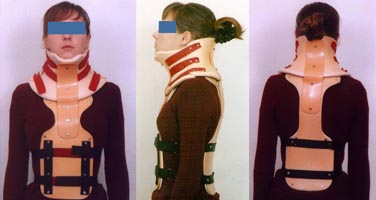
cervicothoracolumbar fixation

Quantitative evaluation of orthotic quality based on US Dopplerometry of the femoral vein

and stethography
Varieties of trunk orthoses for the treatment of patients with thoracic and lumbar spine pathology

for finger joints

for the elbow joint

for the elbow joint in the case of osteosynthesis using the AZF of the elbow bone

of both forearm bones

and the humerus

for the knee joint

Quantitative Indicators of Redirection Research
Varieties of Redirection Express Orthoses

varieties

measurement and issuing
Individual Orthopaedic Insole Inserts

scheme of corrective reconstructive-subtalar arthrodesis of a short stump with osteosynthesis using a compression pin-rod device

express prosthesis for the foot stump

shin

thigh
Varieties of Express Prostheses for Lower Limb Stumps